![[tkd]](../img/tkd/tkd-vert-black.png)
| DAY | TIME | VENUE |
|---|---|---|
| Monday | 7pm - 9pm | Charles Wilson Sports Hall |
| Wednesday | 5.30pm - 7pm | Manor Road Activity Room |
| Saturday | 2.30pm - 4pm | Manor Road Activity Room |
| Sunday | 4pm - 6pm | Manor Road Activity Room |
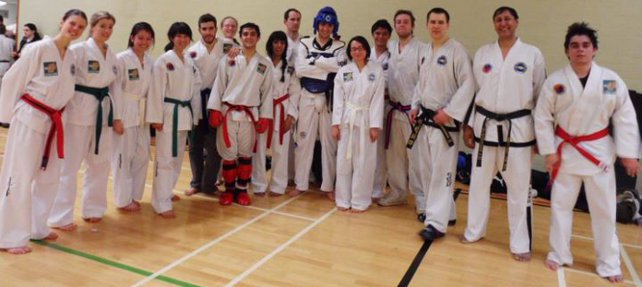
Monday, Wednesday and Sunday are our main training days. These consist of a light warm-up and stretching, followed by work on techniques using linework, patterns, padwork, and sparring. Saturday sessions are squad training, focusing on stamina and sparring training, particularly more advanced sparring techniques.
During the summer, it is not unknown for training to take place outside when the weather is nice, especially during the exam period when Monday sessions are disrupted but can often be relocated to Victoria Park.
Training usually continues out of term time, depending on numbers and availability of instructors. These sessions are usually less formal, although are often just as hard work as normal sessions if not more so. Contact the Committee for out of term training details.
Students are encouraged to keep their fitness levels up and practice, especially patterns, when away from Uni for holidays etc., as this will lead to less of a shock when recommencing training. This especially applies to senior grades, who are expected to have to work in their own time to maintain acceptable levels of fitness and knowledge.
Please arrive in good time for training, thus allowing the session to start on time and avoiding the need for penalty exercises.
Graded members should wear full dobok, which should be clean and, ideally, ironed (!); and a belt appropriate to their rank. This is partly because to do otherwise shows a lack of respect to the art and to the instructor, but also allows the instructor to tell at a glance what level a student has reached, and allow the lesson to be directed accordingly.
Beginners should wear loose, comfortable clothing, such as a t-shirt and track suit bottoms.
Trainers may be worn to warm up in if you have an injury or similar that requires it, otherwise all training will be done in bare feet unless you have Taekwon-Do specific training shoes (available from martial arts suppliers).
Students will be allowed to take part in sparring at the instructor's discretion. Usually, students will only be allowed to spar if equipped with a full set of protective pads. However, the instructor may allow under-padded students to take part in more restricted (e.g. no contact) sparring according to their experience and ability.
Students who fight over-enthusiastically (i.e. above the level of contact expected for their grade and opponent's abilities) may be cautioned by the instructor. Repeated cautions, or behaviour resulting in injuries to others will result in sanctions.
When entering the Dojang the student should bow to the instructor, or if not present to where the instructor would normally stand at the beginning of the class. Before the class has started it is not necessary for the instructor to acknowledge the bow.
Students should be correctly dressed before entering the dojang.
Any student who is late for class must wait for the instructor's permission before joining the class. Penalty exercises may be awarded at the instructor's discretion.
If the instructor is late for a session, the most senior student present should line up the class and commence training sessions promptly with a warm up until the instructor arrives.
Students should line up according to rank, starting with the highest rank at the front right hand side. The number of students per line will depend on the size of the Dojang or class. Students without complete uniforms on are outranked by those in proper uniform. It is expected that students will move along the line to accommodate higher-ranking students. When the instructor is ready and at the front of the class the instructor will call the class to attention (charyot), and bow (kyong-ye).
If a student arrives late to the class or re-enters after leaving the Dojang for any reason they should bow and wait for the instructor to allow them to enter. This is not only good manners, but is also for safety reasons. If a student needs to leave the class for any reason they should first get permission from the instructor, normally by raising their hand. When the students are lined up, if the instructor calls out a student to the front they should not walk through the lines; rather they should take one step back and walk to the nearest end of their line and proceed to the front. When re-joining the lines they must do the same in reverse.
No jewellery, watches etc to be worn during class.
No smoking or gum chewing inside the Dojang.
Students must keep finger and toenails clipped short and clean.
Uniforms should be kept clean at all times, and ironed for gradings.
No horseplay, whistling or loud talking in the Dojang.
Never lean on walls or lay spread out on the floor unless while exercising.
Students should behave in a disciplined manner while training. Never lose your temper in the Dojang - especially during sparring.
No talking during class except to ask a question. Before asking a question raise your right hand to attract the instructor's attention.
While in the Dojang, always address the instructor and assistants as Sir or Ma'am, or 'Mr' or 'Ms' using the instructor's surname.
Respect all members of senior grade.
While fixing your Dobok or belt turn 90 degrees to the right.
Turning up to training sessions a couple of times a week will in itself be enough to improve fitness, flexibility and general health, and will probably be enough for most people. Some, however, will want more than this; particularly at the higher grades when being fitter, stronger and more flexible makes life much easier; or for tournaments where a less technically skilled but fitter competitor can defeat someone who is, on paper, a better fighter but can't keep going for the full round. The items below are a small collection of links to get you started (links open in a new window).